Pages

Showing posts with label Digital Cameras. Show all posts

Saturday, 20 July 2013

New screen tech displays clear 2D and 3D images at once

Like her mittens, the 3D glasses might one day be optional (Photo: Miki Yoshihito)
Like her mittens, the 3D glasses might one day be optional (Photo:University of California Santa Cruz have developed a 3D display which can also be viewed in 2D without glasses, and without the blurred effect caused by overlapping images. Though, as you'd expect, the screen displays both left and right images, it also emits a mysterious third image which is the key to the technology.
Regardless of whether active or passive 3D technology is at work, glasses-based 3D televisions rely on those glasses to selectively show each eye one of two pictures displayed on the screen. Because the two images are shot from slightly different perspectives (mimicking the slightly different views we'd see with each eye), our brain is able to put the two images together, creating the three-dimensional effect. But without glasses, both eyes see both pictures at once, creating the blurred effect that renders glasses-based 3D pictures all but unwatchable without the appropriate eyewear.
Not so UCSC's new technology, which cleverly uses a third image which remains apparently unseen to viewers, whether or not they're wearing 3D specs. Viewers without glasses will only see the left image because the right is cancelled out by the third, which is an exact negative of the right. 3D glasses mask the third image altogether.
The technology isn't perfect because it compromises the available contrast to 2D viewers and so, as a compromise, the researchers show 3D viewers a dimmer image to the right eye and a brighter image to the left. According to a UCSC press release, the researchers found that brightness ratios between 20 and 60 percent were "acceptable" to viewers of both 2D and 3D pictures.
The researchers' prototype was "built" using an ordinary 3D projector, with the negative image overlaid using a separate 2D projector. The researchers used active 3D glasses, in which shutters in the left and right eye open and close in sync with the on-screen images, creating the 3D effect. The synchronization additionally meant that the the 2D negative of the right image remained unseen by glasses wearers.
UCSC student Jing Liu is looking into the possibility of commercializing the technology.

Sunday, 23 June 2013

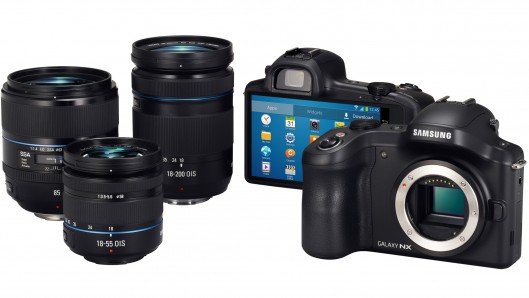
Samsung Galaxy NX brings Android to interchangeable lens cameras

The Samsung Galaxy NX is the world's first interchangeable lens camera to run on Android
The recently announced Samsung Galaxy NX is the world's first interchangeable lens mirrorless camera to run on Android. Unlike previous Android-powered shooters, the NX boasts some serious photographic credentials, including a 20.3-megapixel APS-C format sensor and a hybrid autofocus system. It also features 3G/4G LTE and Wi-Fi technology for instant sharing.

Lytro camera gains wireless capabilities and an iPhone app

The Lytro camera has been given a wireless boost with a new firmware update
The Lytro camera has gained wireless capabilities and a new friend in the iPhone, thanks to a functionality-adding firmware update. Its new-found Wi-Fi capability means the light field camera can work with an equally new iPhone app, which allows users to share and view refocusing pictures while on the go.

Previously, users had to import their living pictures (as Lytro likes to call them), via a desktop application, before uploading them for sharing. But, following on from an update that added manual controls, the camera has now received another that turns on its wireless capabilities.

Saturday, 22 June 2013

Pentax brings a splash of personalized color to the K-50 DSLR

There are 20 body colors to choose from and six grip colors, with buyers being able to select from up to 120 combinations
When it comes to outlandish color schemes for digital SLR cameras, Pentax surely takes the crown. With the launch of its K-50 mid-range DSLR, Japan's photography giant is putting the choice of camera body color firmly in the hands of its customers. There are 20 body colors to choose from and six grip colors, with buyers being able to select from up to 120 combinations. The new 16 megapixel camera includes a broad sensitivity range, an 11 point tracking autofocus system, and an optical viewfinder with 100 percent field of view. It's joined by the similar, but cheaper, K-500 entry-level DSLR.

Tuesday, 18 June 2013

STABiLGO keeps your GoPro on an even keel

The motorized, computerized STABiLGO GoPro stabilizing rig
Looking for smoother hand-held video, but wanting something a little more high-tech than the SteadiCam Smoothee? Well, you might be interested in the STABiLGO. Designed for use with the GoPro HERO2 or HERO3, the gimbal-mounted stabilizing rig utilizes a gyroscopic sensor, a 32-bit high-speed microcontroller, and two electric motors to keep the camera horizontally and vertically level at all times.